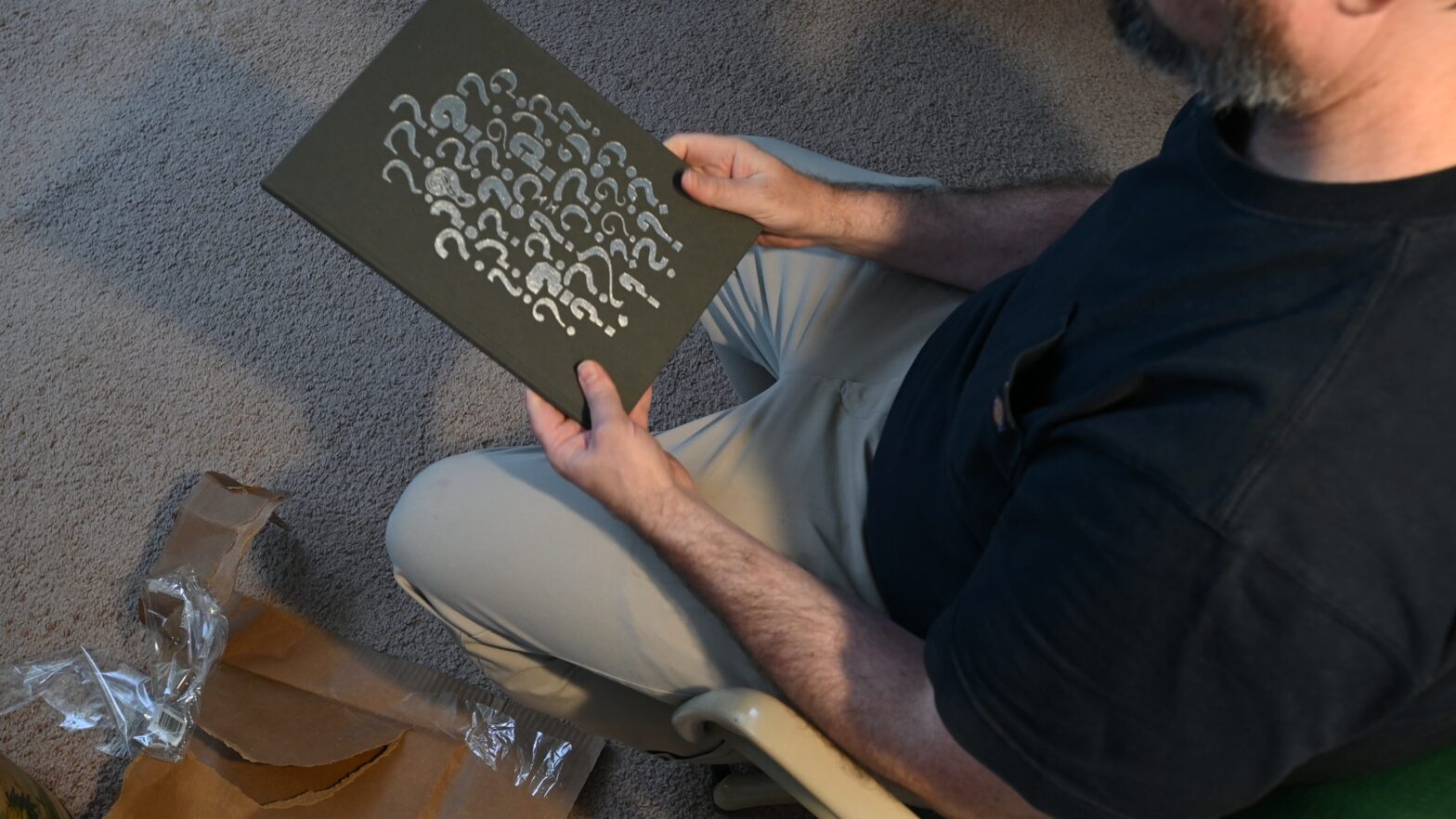
I quite enjoyed Karen Knorr’s Country Life (reviewed here). As such, near the end of that review, I went hunting for other of her books and came across Questions (After Brecht). Given my love of books that combine images and text, and my admiration for David Campany (who interviews Knorr in the back of the book), I snapped up a copy immediately.
Just to get this out of the way first: Questions is not Country Life.
In a footnote to my Country Life review, I claimed to be “most interested” in whatever the was doing in Questions, and explained briefly that I wasn’t much interested in her work between the two, the photographs of various interiors with unrelated people inserted in the darkroom (or software). Why? Eh. I don’t quite know. I’m something of a purist, I guess, and for no good reason, so maybe I wanted to expand my horizons or something.
With Questions, Knorr traded in the compositing tools, instead opting to colorize, paint, add a bit of makeup to her photographs of La Samaritaine, which was under construction, being subdivided into a network of smaller departments, when the photographs were made. The Brecht poem reads as sort of heavy handed to me, and to be honest, without the interview with David Campany that appears at the end, I probably wouldn’t get anything out of Questions at all. The colorization just doesn’t quite land, for me. Thankfully, Campany gives Knorr the opportunity to stretch out a bit and give some (for my limited imagination) much needed context for the work.
For someone more cosmopolitan and worldly and in the know than me, someone who knows what La Samaritaine is and knows something of its history, the Brecht might make some sense. As Campany points out,
[1935]… is the year of Bertolt Brecht’s ‘Questions of a worker who reads,’ which provides the textual counterpoint [to Questions]. It is the year of Walter Benjamin’s essay ‘Paris, Capital of the Nineteenth Century,’ his great account of the shopping arcade as the key to understanding commodity capitalism. But it is also the year of the death of Frantz Jourdain, the Belgian architect and theorist of Art Nouveau, who was commissioned to revamp and expand the original La Samaritaine department store.
82 years later, Knorr began photographing La Samaritaine as it was once again being revamped.*
Now. Brecht (and Benjamin) lived in a time when women were largely invisible in public discourse. Brecht’s “worker who reads” is unquestionably male. And even today, construction trades remain largely dominated by men. There’s no good reason for this, I suppose, and while Rosie the Riveter is an icon, and while women make up a large portion of the overall workforce here in the latter 2020s, men still dominate construction and women still dominate department store staff.
This is the key, I think. Knorr looked at the under-construction department store and saw the future, glittery, largely feminized space of commerce. Later, in the computer, she used the files from a Phase One 180 digital back and added color—probably in photoshop, and maybe in my digital darkroom of choice, Phase One’s own Capture One Pro—to call attention to the inherent sexism and exclusion in capitalism, maybe.
Would I have gotten all of this out of the photographs and Brecht text alone, without the benefit of the interview? Given how dense and dim I am, that’s doubtful, and with the book in hand, I’m less interested in the work than I wanted to think I was. Yes, wage labor is gendered, and for very little compelling reason. And Brecht’s critique can and should be applied to all people. Perhaps Knorr’s Questions is a good reminder of this.
Unrated.
I sat on this review for more than a month, and just hammered out most of the above on a Sunday morning while most of the house was asleep. Maybe some of it makes sense. If you’re interested, Knorr’s Questions (after Brecht) remains available direct from the publisher and at various retailers, and you should go look through her archive. She makes great work that I probably don’t appreciate to the extent it deserves.
*LVMH acquired a majority stake in La Samaritaine in 2001. The store closed in 2005. LVMH bought the remaining shares in 2010 and began a multi-year restoration that was apparently ongoing as of 2017 and ’18 when Knorr made the photographs for Questions. {Source.}