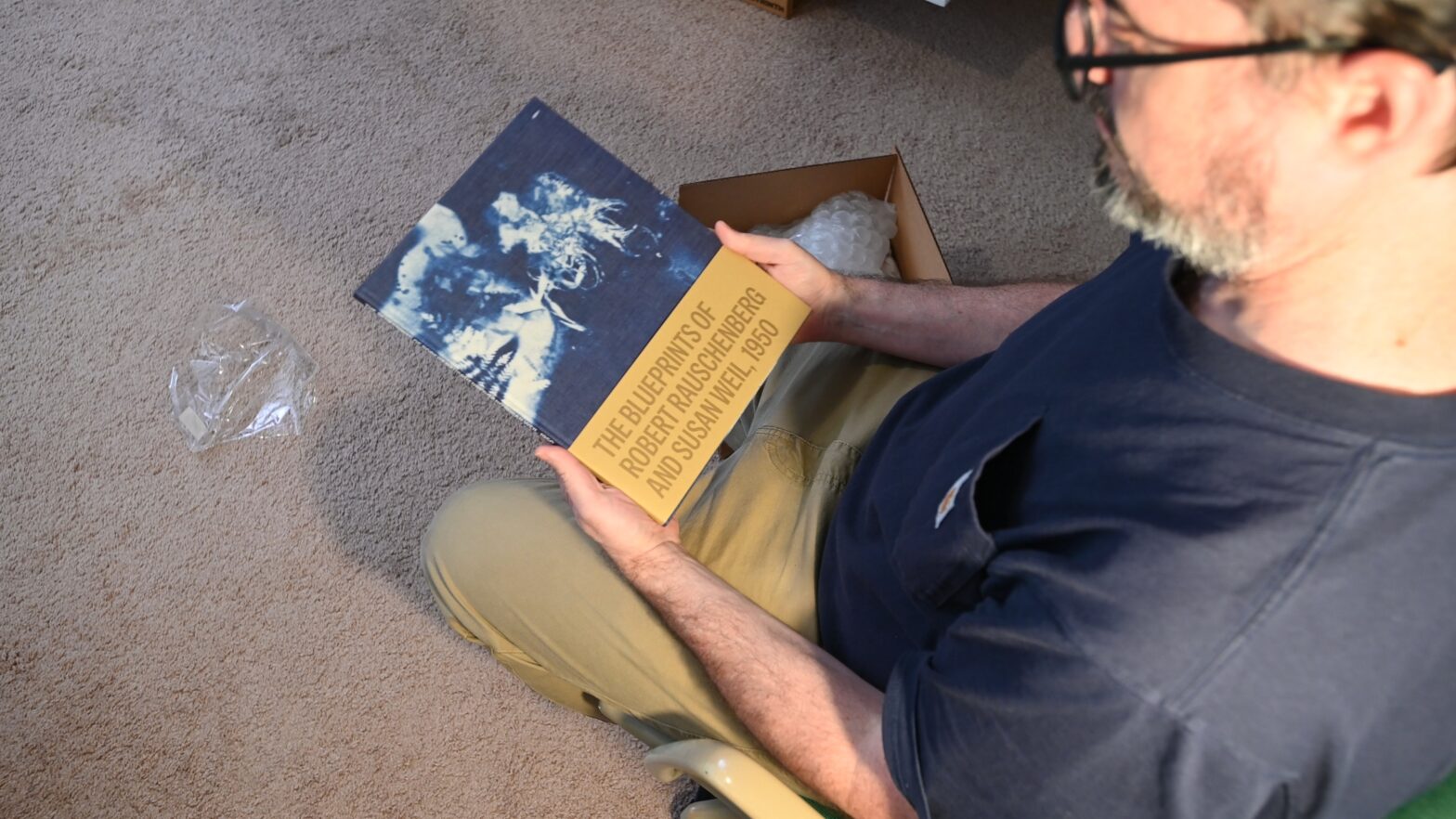
I’m something of a sucker for so-called alternative processes, and when I received an announcement email regarding Stanley/Barker’s publication of The Blueprints of Robert Rauschenberg and Susan Weil, 1950, I started to insta-buy, then remembered that Rachel Barker once offered to send me review copies on request, and so here we are.
This is, therefore, a sponsored post.
Before I begin, here’s what I know about the blueprint process. Short answer, and the only answer, really: blueprints are cyanotypes… same materials, same process, slightly different application, and, in the case of Rauschenberg and Weil, the size. If you’re still curious, here’s Wikipedia and the Film Shooter’s Collective on the format.
The book is made up of three sections: plates from Rauschenberg’s “Blueprint Portfolio” and Weil’s archive; an interview between Lou Stoppard and Weil condensed from a Zoom chat and emails in mid 2025; and some photographs of Rauschenberg and Weil, their studio and process, and some other works, taken in 1951 by Wallace Kirkland as part of an assignment from Life magazine. Together, The Photographs of Robert Rauschenberg and Susan Weil, 1950 is a simple and concise document of an early collaborative series from the two artists.*
So what’s the story? Really, it’s Weil’s story: her grandfather ran an architectural firm and made a blueprint portrait of her grandmother that remains in her possession. She introduced Rauschenberg to the blueprint process and taught him how to do it. They collaborated—in the traditional sense, not in some kind of weird muse/artist thing—on the work for 18 months or so between 1949 and 1951. Weil continued working with blueprints off and on to the present day, and in an ArtForum announcement about the discovery of Kirkland’s photographs (2016), Michael Lobel claims to see evidence of the process in Rauschenberg’s later, more well known work. For my part, I’m not entirely sure: my familiarity with his work is largely from textbooks, a bit from museums, and entirely decades old, and Lobel probably knew what he was talking about.
The blueprints themselves vary, from geometric abstraction to floral studies to figurative works, and it looks like they had some fun. If you know cyanotypes, then you know that anything touching the paper is mostly focused, and anything at any distance blurs nicely. Rauschenberg and Weil used this to great effect, suggesting movement and the progression of time across and through the picture plane. Their titles, the few that have titles, remind me of some of the fun I had in Art School as I named things, and suggest nothing more than youth, to middle-aged me, even though I might still name things in fun ways.
The interview gives some nice context from Weil’s viewpoint. She doesn’t blame Rauschenberg for the lack of attention she received, and does resent when people talk about “Bob’s Blueprints,” because a) she was there too, making them with “Bob,” and b) without Susan, Bob would never have made “his” blueprints. 1950 was a long time ago. My parents weren’t born yet. Women were seen very differently in society at large, and Weil talks about this some. My mom was the first woman to be anything more than a secretary at the accounting firm where she started her career (1983 or 84), and while the “old boy’s club” has partially disappeared in more recent decades, the system they left behind is still running, and mostly remains just as exclusionary and self-important as it always was. And, yes, I’m saying this as someone with a recent (and perhaps ongoing?) relationship with a photobook publisher that sent me this wonderfully interesting book with no expectation of anything (while also knowing that I run a photobook unboxing and flipthrough channel on YouTube and occasionally still write reviews on my vanity blog here), so maybe I should shut up.
Anyway.
The photographs might show a young artist working his craft and trying to hone his image. At first glance, I just saw some mimed action (blueprints require UV light, and photographs require visible light: it was savvy of Rauschenberg and Weil to demonstrate things in ways the camera could see). Looking again, though, it’s easy to see that Rauschenberg is busily trying to gain exposure. For her part, Weil barely appears. Maybe that’s her shoe in one or two pictures. In one she sits on a toilet, holding a bucket while Rauschenberg sponges down a fresh blueprint; in another, she’s blurred, crammed up on the edge of the frame, directing Rauschenberg’s hand as he exposes a print. (The ArtForum article linked above has some additional photographs.)
Taken together, The Blueprints of Robert Rauschenberg and Susan Weil, 1950 is a fantastic document and I’m fortunate both to have it in my collection, and privileged to have a small relationship with Stanley/Barker. Apologies to Rachel and everyone at Stanley/Barker for taking so long to review this great book.
Unrated.
Susan Weil continues making work, and her website is worth a visit, and the Robert Rauschenberg Foundation is, of course, very active and has a nice chronological listing of Rauschenberg’s work, including several of the blueprints that appear in the book. For two, active, artists who went to the same schools at the same time, and were even married and had a child together, it’s sort of interesting how their trajectories differed. Or, maybe not… In the interview portion, Weil mentions how Rauschenberg could just go make things happen: he got the meeting with Edward Steichen, who ended up putting one of the blueprints in a show at the Museum of Modern Art, New York; Rauschenberg knew someone at Bonwit Teller that helped them get a commission to do backdrops for the window displays. Meantime, Weil was a mother and, while she made art the whole time, she also cooked, cleaned, looked after the children, etc. Rauschenberg had the time and, more importantly, drive and ego to go knock on doors and network and all. Weil had other priorities and a different personality.
I think of myself and Joe Miller: we were/are good friends and he was a year ahead of me in art school. He went on to get an MFA and I moved to Art History and Criticism. He continues working as an artist full time, and I’m the lowest possible level manager at a financial services company. Joe made it happen, and continues to. I never even tried. Neither of us are likely to have foundations bearing our names spring up after our death; Joe might one day have work in various museums around the world, if he doesn’t already. And we’re both men, living and working in a different world. And speaking of classmates, do we even know any of the people that went to Black Mountain College with Weil and Rauschenberg? Black Mountain was famous and tons of big names went there… Weil mentions other students that wanted to “go to the dump,” where Weil and Rauschenberg like to hang out… she doesn’t say, who they were, and Stoppard, the interviewer, doesn’t dig. She doesn’t name anyone, really: it’s always the interviewer that brings up any Big Names. Weil just wants to talk about her own work, and rightly so.
Anyway. The book is fantastic and while I did receive it for purposes of review, nobody paid me to say that.At time of writing, copies remain available direct from Stanley/Barker and likely elsewhere. If you have any interest in alternate processes in general, or cyanotypes and blueprints in general, or if you’re a Rauschenberg and/or Weil fan, do yourself a favor. Good stuff.
*If it wasn’t made entirely clear earlier, yes, Susan Weil is an artist too, with works in the collections of the Metropolitan Museum of Art and MOMA (New York), the Victoria and Albert Museum (London), the Getty Museum (LA) and elsewhere. That said, and showing the institutional blindness to the contributions and work undertaken by women, Weil’s first major New York exhibition happened at Shirley Fiterman in 2025. It’s telling that the title of this exhibition was “About Time.”